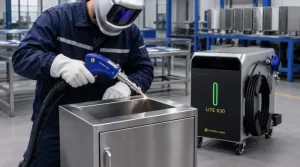
Refrigeration equipment manufacturing involves much more metal fabrication than many people realize. Commercial refrigerators, HVAC equipment, refrigeration cabinets, cooling units and industrial refrigeration systems may contain stainless steel enclosures, carbon steel frames, galvanized panels, aluminum components, refrigeration valves, brackets and other welded assemblies.
For manufacturers producing these components, welding quality directly affects product appearance, dimensional accuracy, production efficiency and downstream assembly.
A handheld laser welder for refrigeration equipment provides manufacturers with a flexible welding solution for many of these applications, particularly where thin sheet metal, visible seams and repetitive production are involved.
Compared with conventional welding processes, handheld laser welding can help manufacturers control heat input, reduce thin-sheet distortion and decrease post-weld grinding when the equipment and process parameters are correctly matched to the workpiece.
Why Refrigeration Equipment Manufacturing Creates Difficult Welding Requirements
Refrigeration and HVAC products often combine several types of metal components within the same manufacturing process.
Typical components may include:
- Refrigeration equipment cabinets
- Commercial refrigerator housings
- HVAC and ventilation enclosures
- Refrigeration valves
- Compressor mounting brackets
- Equipment frames
- Stainless steel panels
- Access doors
- Protective covers
- Internal structural supports
These components can create several welding challenges.
Thin-Sheet Distortion
Many refrigeration housings and cabinets use relatively thin sheet metal. Excessive heat input can cause:
- Panel warping
- Door misalignment
- Uneven surfaces
- Dimensional errors
- Additional straightening work
For visible stainless steel or coated components, deformation can also reduce the appearance quality of the finished product.
High Appearance Requirements
Commercial refrigerators, food-service equipment and stainless steel cooling equipment often contain visible metal surfaces.
Manufacturers therefore need to control:
- Weld discoloration
- Spatter
- Burn marks
- Grinding marks
- Uneven weld seams
A clean and consistent weld can reduce the amount of polishing and surface finishing required before final assembly.
Multiple Materials in One Factory
A refrigeration equipment manufacturer may process several metals, including:
- Stainless steel
- Carbon steel
- Galvanized steel
- Aluminum
- Copper or copper-alloy components
This means the welding process needs enough flexibility to support different materials, thicknesses and joint designs.
Where Can Handheld Laser Welding Be Used in Refrigeration Manufacturing?
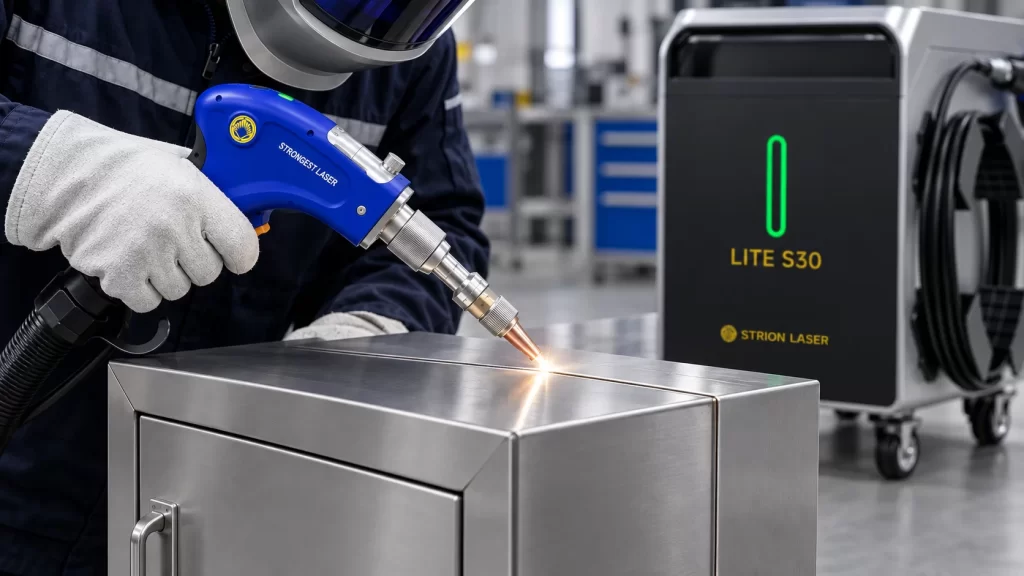
A handheld laser welder for refrigeration equipment can be used across cabinet fabrication, HVAC housings, refrigeration components and other sheet-metal production tasks when the workpiece and welding requirements are suitable.
Refrigeration Cabinets and Equipment Housings
Metal cabinets and housings are one of the most suitable refrigeration manufacturing applications for handheld laser welding.
Common welding areas include:
- Cabinet corners
- Door frames
- Side panels
- Top and bottom panels
- Internal reinforcement structures
- Mounting brackets
Because these parts frequently use thin stainless steel or galvanized sheet, controlling heat input is important for maintaining flat surfaces and accurate cabinet dimensions.
Commercial Refrigerators and Stainless Steel Cooling Equipment
Commercial refrigeration equipment used in restaurants, supermarkets, hotels and food-processing facilities often requires extensive stainless steel fabrication.
Typical products include:
- Refrigerated display cabinets
- Commercial refrigerators
- Cold-storage equipment housings
- Stainless steel cooling tables
- Food-service refrigeration cabinets
For these products, manufacturers usually need both reliable joints and a clean external appearance.
HVAC and Ventilation Equipment
HVAC products contain many sheet-metal components that may benefit from handheld laser welding.
Applications can include:
- Air-conditioning housings
- Ventilation cabinets
- Air-handling units
- Equipment covers
- Control boxes
- Internal frames and supports
For manufacturers producing several product sizes, the mobility of a handheld welding head can be useful when operators need to work around large or complex assemblies.
Refrigeration Valves and Metal Components
Refrigeration systems also contain smaller metal components such as valves, brackets, connectors and support parts.
The suitability of handheld laser welding depends on:
- Component geometry
- Material type
- Wall thickness
- Required weld penetration
- Leak-tightness requirements
- Production and quality standards
Components that form part of a sealed refrigeration circuit should be validated according to the manufacturer’s pressure, leakage and quality requirements before mass production.
More application examples can be found in STRION LASER’s handheld laser welding applications.
Why Handheld Laser Welding Works Well for Thin Refrigeration Panels
A handheld laser welder for refrigeration equipment can be particularly useful for thin-sheet cabinets and housings where manufacturers need to control heat input and maintain dimensional accuracy.
One of the main advantages of laser welding is concentrated energy input. The welding energy is focused around the joint rather than heating a large surrounding area.
When appropriate parameters are used, this can help reduce unnecessary thermal influence around thin sheet metal.
Reduced Panel Deformation
Controlled heat input can help manufacturers maintain:
- Flatter sheet-metal panels
- Straighter cabinet corners
- More accurate enclosure dimensions
- Better door and panel alignment
This can reduce correction work during final assembly.
Cleaner Visible Welds
Handheld laser welding can produce narrow and consistent weld seams when joint condition, welding speed and process parameters are properly controlled.
This is especially valuable for stainless steel refrigeration equipment where customers can see the finished metal surface.
Reduced Grinding and Polishing
Traditional fabrication may require several operations after welding:
- Grinding
- Spatter removal
- Surface correction
- Polishing
- Final cleaning
Reducing these secondary operations can improve the total production efficiency of refrigeration equipment manufacturing.
Materials Commonly Used in Refrigeration Equipment
Stainless Steel
Stainless steel is widely used in refrigeration and food-service equipment because of its corrosion resistance, durability and clean appearance.
Common applications include:
- Commercial refrigeration cabinets
- Food-processing equipment
- Cooling tables
- Stainless steel housings
- Visible exterior panels
Thin stainless steel is particularly suitable for evaluating handheld laser welding because excessive thermal deformation can significantly affect product appearance and assembly accuracy.
Galvanized Steel
Galvanized sheet is commonly used for internal panels, ventilation products, housings and other industrial equipment components.
Because the zinc coating changes the behavior of the material during welding, the process should be tested carefully and suitable fume extraction should be provided.
Carbon Steel
Carbon steel is frequently used for:
- Frames
- Structural brackets
- Equipment bases
- Internal supports
These components may later receive painting, powder coating or other surface treatments.
Aluminum
Aluminum is useful where manufacturers need lighter components and corrosion resistance.
However, aluminum has relatively high thermal conductivity and requires suitable control of laser power, travel speed, surface preparation and shielding gas.
Production parameters should be verified on representative parts before mass manufacturing.
Handheld Laser Welding vs TIG for Refrigeration Equipment
When comparing TIG with a handheld laser welder for refrigeration equipment, manufacturers should evaluate not only welding speed but also deformation, finishing requirements and production consistency.
| Factor | Handheld Laser Welding | TIG Welding |
|---|---|---|
| Heat input | Highly concentrated | Broader heat input |
| Thin-sheet distortion | Can be reduced with suitable parameters | Higher heat input can increase deformation |
| Welding speed | High productivity potential | Generally slower |
| Visible weld appearance | Narrow and clean seams are possible | High quality but strongly operator-dependent |
| Post-processing | Can reduce grinding and polishing | More finishing may be required |
| Operator consistency | Digital parameters can improve repeatability | Greater dependence on welding skill |
| Initial equipment investment | Higher | Lower |
The correct process still depends on the actual component and quality requirements.
TIG welding remains useful for many specialized joints, repair tasks and lower-volume applications, while handheld laser welding becomes attractive when manufacturers need higher throughput, consistent appearance and controlled heat input on repetitive metal components.
Joint Design and Fit-Up Are Critical
A handheld laser welding machine cannot compensate for unlimited joint gaps or poor part preparation.
Consistent fit-up helps improve:
- Weld penetration
- Seam appearance
- Production repeatability
- Wire feeding stability
- Overall weld quality
Refrigeration equipment manufacturers should therefore also evaluate upstream fabrication processes such as:
- Laser cutting
- Sheet-metal bending
- Punching
- Fixture design
- Component positioning
Better part accuracy usually makes the welding process easier to control.
When Is Filler Wire Needed?
Some thin-sheet refrigeration components can be welded without filler wire when the joint gap is small and fit-up is accurate.
Wire feeding may be useful when manufacturers need to:
- Fill larger joint gaps
- Increase weld reinforcement
- Improve tolerance to part variation
- Meet specific joint-strength requirements
The wire material and diameter should be matched to the base material and actual welding requirement.
Shielding Gas and Weld Appearance
Shielding gas protects the molten weld pool from the surrounding atmosphere.
Incorrect gas selection, insufficient flow or unstable coverage may contribute to:
- Oxidation
- Discoloration
- Porosity
- Poor weld appearance
This is especially important for visible stainless steel refrigeration components.
How to Reduce Distortion in Refrigeration Cabinet Welding

Use Appropriate Laser Power
More power does not automatically mean better welding.
The objective is to use enough energy to achieve the required penetration without introducing unnecessary heat into the workpiece.
Maintain Consistent Welding Speed
Moving too slowly can increase heat input, while moving too quickly may result in insufficient penetration or incomplete fusion.
A stable travel speed helps maintain consistent weld quality.
Control Joint Gaps
Large or irregular gaps can make thin-sheet welding more difficult and may increase the need for filler wire.
Use Fixtures When Necessary
Suitable fixtures can help maintain:
- Corner alignment
- Panel position
- Joint gap
- Cabinet dimensions
Test Representative Parts
Process development should be completed using actual or representative components before beginning large-volume production.
How to Choose a Handheld Laser Welder for Refrigeration Equipment
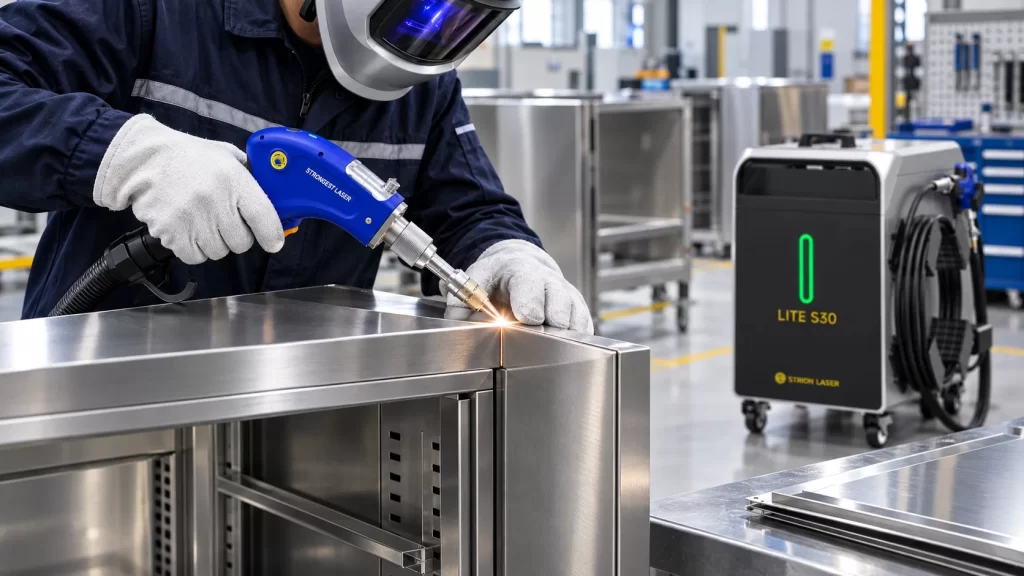
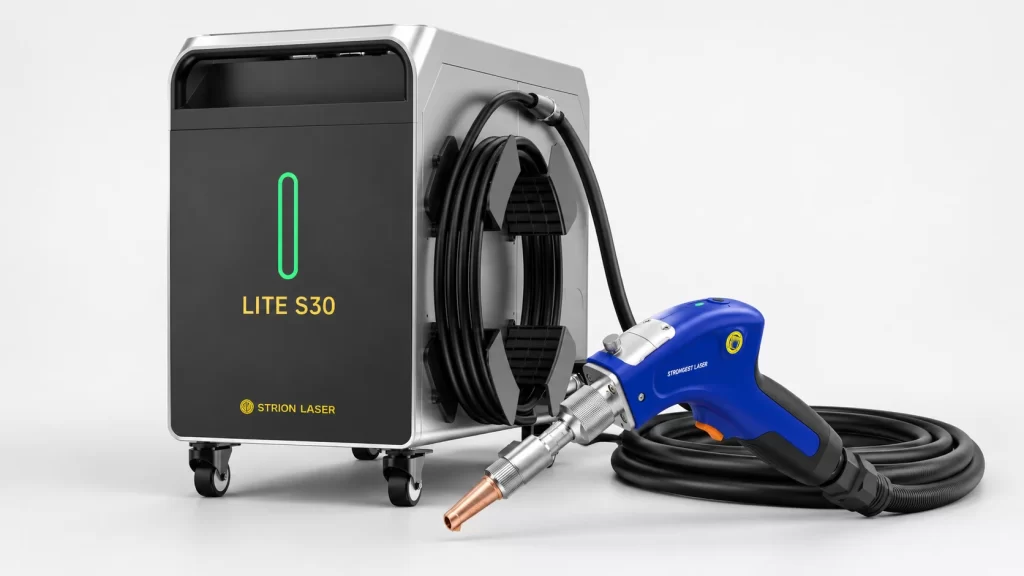
Selecting the right handheld laser welder for refrigeration equipment should begin with the actual material, thickness, joint design and production requirements instead of machine power alone.
1. Material and Thickness
First identify:
- Main material
- Minimum thickness
- Maximum thickness
- Typical joint type
A factory primarily welding thin stainless steel refrigeration cabinets has different requirements from a manufacturer welding heavier carbon steel equipment frames.
2. Production Volume
Consider:
- Number of components per shift
- Total weld length
- Number of product models
- Required production cycle
Production volume affects the appropriate power level, duty requirements and equipment configuration.
3. Portability
Large refrigeration cabinets and HVAC products can be inconvenient to reposition continuously.
A compact machine and flexible welding cable can make it easier for the operator to move around the workpiece.
4. Welding Head Ergonomics
For long production shifts, welding head weight and grip design affect operator fatigue.
This is particularly important when operators need to weld long cabinet seams or access different sides of a large enclosure.
5. Laser Power Selection
Higher power is not automatically the correct choice.
The appropriate power should be selected according to:
-
- Material type
- Material thickness
- Required penetration
- Welding speed
- Production duty
For additional guidance, see the STRION LASER handheld laser welder power selection guide.
6. Cooling and Thermal Management
Handheld laser welding equipment requires an effective cooling system to maintain stable laser output during continuous operation.
This is a different question from whether the machine is used to manufacture refrigeration equipment.
Depending on machine design, handheld laser welders may use different thermal-management methods.
The best handheld laser welder for refrigeration equipment is therefore the one matched to the actual workpiece, material thickness, production volume and quality requirements.
What Does a Refrigerant-Cooled Handheld Laser Welder Mean?
The term refrigerant-cooled handheld laser welder describes the thermal-management technology used inside a welding machine.
It does not mean that the machine can only be used to manufacture refrigerators, HVAC systems or other refrigeration products.
Likewise, a handheld laser welder used for refrigeration equipment manufacturing may use different cooling technologies depending on the equipment design.
Manufacturers should therefore separate two questions:
- What products will the machine weld?
- How is the laser welding machine itself cooled?
Both questions affect equipment selection, but they describe different technical requirements.
What Information Should You Prepare Before Requesting a Welding Solution?
| Information | Example |
|---|---|
| Product | Commercial refrigeration cabinet |
| Material | 304 stainless steel |
| Thickness | 1–3 mm |
| Joint type | Corner / Lap / Butt |
| Weld length | Specify per component |
| Production quantity | Units per day or month |
| Existing process | TIG / MIG / other |
| Main problem | Distortion / speed / finishing time |
| Appearance requirement | Visible stainless steel surface |
| Photos or drawings | Recommended |
This information allows the supplier to recommend a welding configuration according to the real manufacturing process instead of relying only on general machine specifications.
Frequently Asked Questions
Can handheld laser welding be used for refrigeration equipment?
Yes. Handheld laser welding can be evaluated for many refrigeration equipment components including cabinets, enclosures, frames, brackets and other metal parts. Suitability depends on material, thickness, joint design and quality requirements.
Is handheld laser welding suitable for stainless steel refrigerator cabinets?
Yes. Thin stainless steel cabinets are a typical application where concentrated heat input, reduced distortion and clean weld appearance can be valuable.
Can a handheld laser welder weld aluminum refrigeration components?
Yes, depending on the equipment and process configuration. Aluminum requires careful control of surface preparation, shielding gas, laser power and welding speed.
Can handheld laser welding replace TIG in refrigeration manufacturing?
It can replace or supplement TIG welding in some repetitive manufacturing applications, but the best process depends on component geometry, material, quality standards and production volume.
Does a handheld laser welder always need filler wire?
No. Filler wire may be unnecessary for accurately fitted joints, but it can help compensate for gaps or meet specific reinforcement requirements.
What is a refrigerant-cooled handheld fiber laser welder?
It is a handheld laser welding machine that uses a refrigerant-based thermal-management system to help control the temperature of the laser and related components during operation.
Get a Handheld Laser Welding Solution for Refrigeration Equipment
If your factory manufactures refrigerators, HVAC equipment, refrigeration cabinets, cooling equipment, refrigeration valves or related metal components, the welding solution should be selected according to the actual workpiece rather than machine power alone.
Before selecting a handheld laser welder for refrigeration equipment, prepare the following information:
- Product photos or drawings
- Material type
- Minimum and maximum thickness
- Joint design
- Required weld appearance
- Daily or monthly production volume
- Current welding process
- Main production challenges
STRION LASER can then evaluate an appropriate handheld laser welding machine configuration according to your refrigeration equipment manufacturing requirements.