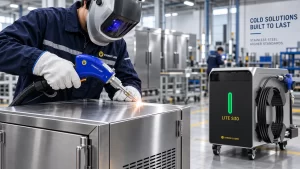
Master X Series Handheld Laser Welding Machine for Power Equipment Sheet Metal Fabrication: Is It Time to Upgrade?
Power equipment manufacturers face a familiar challenge: producing reliable sheet metal components while controlling welding distortion, labor costs and post-weld finishing.
Pipe supports, equipment bases, electrical enclosures, cable brackets and steel frames may look like simple metal components, but their quality directly affects assembly accuracy, installation efficiency and long-term performance.
Traditional TIG and MIG/MAG welding remain widely used in this industry. However, when thin-sheet distortion, manual grinding and inconsistent production quality become recurring problems, manufacturers have good reason to consider a different approach.
A handheld laser welding machine offers an alternative for suitable metal fabrication applications. With concentrated heat input and a flexible handheld design, it can help manufacturers control distortion, improve welding efficiency and reduce some post-weld finishing work.
The STRION LASER Master X Series is designed for industrial laser welding applications across different power requirements. For power equipment manufacturers, the real question is not simply whether laser welding is faster. It is whether the process can produce acceptable welds with less rework and a more efficient overall workflow.
Why Power Equipment Sheet Metal Fabrication Is Challenging
Power equipment fabrication often involves multiple materials, changing plate thicknesses and customized component designs.
One production order may involve stainless steel electrical enclosures. Another may require carbon steel pipe supports, structural brackets or equipment bases. Small-batch production and frequent changes make it difficult to standardize every welding operation.
Three challenges deserve particular attention.
1. Welding Distortion Affects Assembly Accuracy
Thin stainless steel sheet metal can deform when excessive heat is introduced during welding.
Even minor dimensional changes may cause mounting holes to misalign or panels to become difficult to assemble. Correcting these problems takes additional labor and can delay delivery.
Laser welding concentrates energy into a relatively small area. With suitable parameters, joint preparation and clamping, it can help reduce heat spread and control distortion on compatible workpieces.
However, laser welding does not eliminate distortion in every situation. Material thickness, joint geometry, welding speed and fixture design all influence the final result.
2. Weld Quality Depends on Process Consistency
Traditional welding can produce excellent results when performed by experienced operators. The challenge is maintaining consistent quality across different workers, shifts and production batches.
For power equipment manufacturers, weld appearance is only part of the requirement. Penetration, joint strength and compliance with applicable inspection standards also matter.
A properly developed laser welding process can improve repeatability, but it still requires suitable parameter settings, operator training and quality control.
3. Post-Weld Finishing Increases Production Costs
Welding is not always the final manufacturing step.
Depending on the application, components may require grinding, polishing, spatter removal or surface preparation before painting, coating or assembly.
These operations consume labor and occupy valuable workshop time. They can also introduce variation into the finished surface.
The real cost of welding includes everything required to turn a welded component into an acceptable finished part.
That is why reducing unnecessary post-weld finishing can be just as important as increasing welding speed.
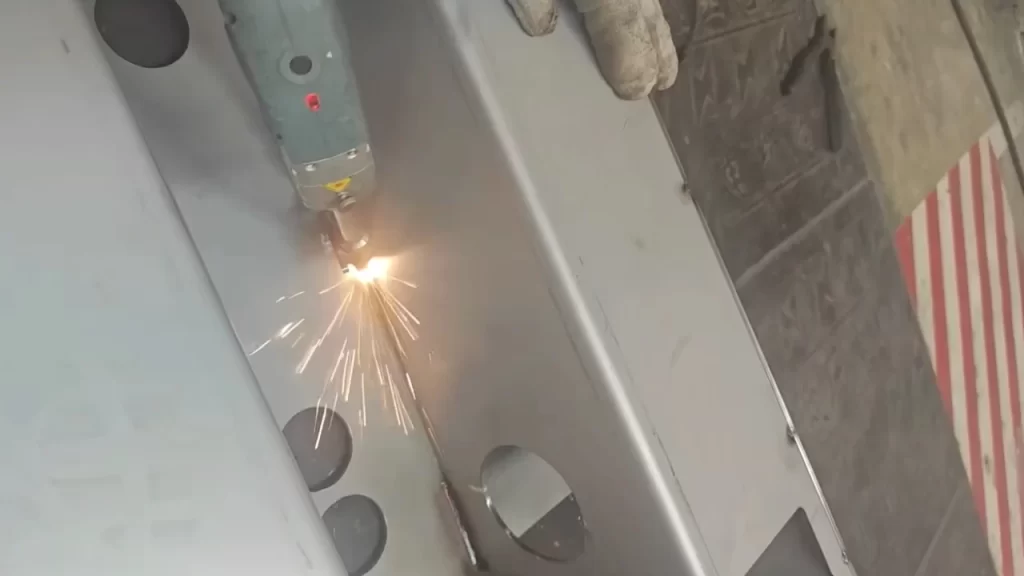
Handheld Laser Welding Machine vs. TIG and MIG Welding
A handheld laser welding machine should not be viewed as a universal replacement for traditional welding. Each process has strengths, and the best choice depends on the workpiece and production requirements.
| Comparison Factor | TIG Welding | MIG/MAG Welding | Handheld Laser Welding |
|---|---|---|---|
| Heat input | Requires careful control, especially on thin sheet | Depends on process settings and material | Concentrated heat input |
| Thin-sheet distortion | Can occur if heat input is excessive | Depends on settings and joint design | Can help reduce distortion with suitable parameters |
| Welding speed | Often slower in manual applications | Suitable for productive welding | Can be faster on compatible joints |
| Weld appearance | Can produce high-quality welds | Spatter and finishing may be concerns | Can produce a consistent finish with optimized settings |
| Operator requirements | Manual technique is important | Technique and parameter control are important | Training and process setup are still required |
| Automation | Possible with suitable equipment | Widely used in automated production | Can be integrated into suitable robotic systems |
The practical difference is not that traditional welding has become obsolete. It is that laser welding gives manufacturers another option when distortion, finishing labor and production consistency become major constraints.
For thicker materials, complex joints or components subject to strict inspection requirements, the proposed welding process should be tested against the actual engineering specification before production adoption.
What Can a Handheld Laser Welding Machine Improve?
The value of a handheld laser welding machine depends on how it fits into the workshop’s existing production process.
For power equipment fabrication, three potential benefits are particularly relevant.
Better Control of Heat Input
Laser welding concentrates energy in a narrow welding area. On suitable sheet metal joints, this can help limit unnecessary heat spread and reduce distortion.
This is useful when welding stainless steel panels, electrical enclosures, brackets and other components where flatness and dimensional accuracy affect downstream assembly.
Good results still depend on appropriate power settings, welding speed, focus, joint preparation and clamping.
Less Grinding and Finishing on Suitable Welds
With the right joint design and process parameters, laser welding can produce narrow, consistent welds with limited spatter.
This may reduce the amount of grinding and polishing needed before the next production stage.
However, not every weld will be ready for use without finishing. The required appearance, penetration and inspection criteria should determine whether additional processing is necessary.
For buyers evaluating laser welding equipment, a useful test is to compare the complete production time, including finishing, rather than measuring welding speed alone.
Flexibility for Different Production Orders
Many power equipment workshops do not manufacture one standardized product all day.
They may switch between enclosures, brackets, supports and equipment frames, each with different dimensions and joint configurations.
A handheld system can offer flexibility for suitable manual welding tasks without requiring a fully automated production cell from the beginning.
The key is to confirm that the equipment can handle the workshop’s most common materials, thicknesses and joint types.
Why Machine Configuration Matters More Than Power Alone
When comparing a laser welding machine, buyers often begin with laser power. Power matters, but it is only one part of the decision.
Cooling performance, optical architecture, welding torch ergonomics, wire feeding, maintenance requirements and automation compatibility can all affect the practical value of the equipment.
Cooling Performance for Industrial Operation
Cooling design influences how a machine manages heat during operation.
For workshops running long shifts or operating in demanding ambient conditions, the cooling system should be evaluated against the intended duty cycle and working environment.
STRION LASER uses a dual-circuit refrigerant direct-cooling design on applicable models. Buyers should confirm the cooling configuration, operating temperature range and duty-cycle requirements of the specific model under consideration.
Optical Architecture and Output Stability
The laser source and optical system are central to welding performance.
STRION LASER develops its own laser technology and uses a proprietary optical architecture on applicable products. When evaluating long-term stability, buyers should request the official specifications and relevant test data for the model they intend to purchase.
Claims about power stability, service life and maintenance requirements should be assessed using documented technical information rather than assumptions based on a product category.

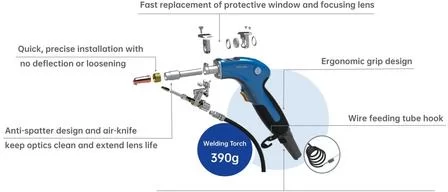
Welding Torch Ergonomics and Maintenance
Handheld welding involves repeated movements throughout a shift. Torch weight, grip, cable handling and access to replaceable protective components can influence operator comfort and maintenance time.
STRION LASER’s K-series welding torch is designed for handheld operation with a lightweight structure and serviceable protective components.
Before purchasing, buyers should evaluate the actual torch configuration, weight, handling requirements and maintenance procedures.
Wire Feeding for Different Joint Requirements
Wire feeding can be useful when a joint requires filler material or when the fit-up creates a gap that cannot be managed by autogenous welding.
Single-wire and dual-wire configurations may suit different applications, but neither is automatically the best choice for every workpiece.
The selection should be based on material, thickness, joint geometry, gap tolerance and the required weld profile.
For manufacturers working with both thin sheet metal and thicker components, testing representative joints is more reliable than choosing a configuration based only on a specification sheet.
STRION LASER Master X Series for Power Equipment Fabrication
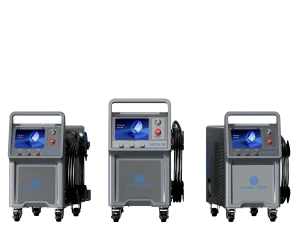
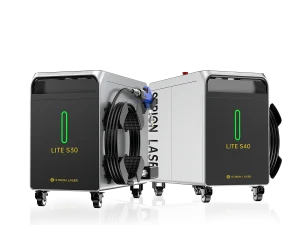
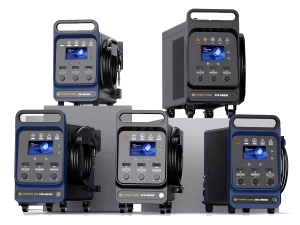
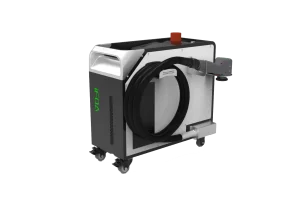
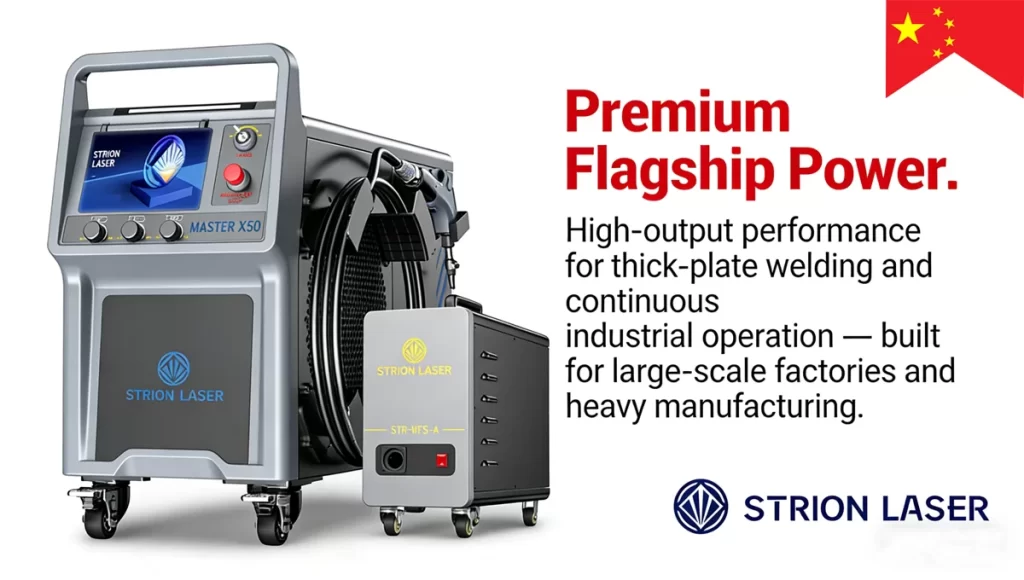
The STRION LASER Master X Series handheld laser welding machine range provides different power configurations for industrial welding applications.
The series includes the MASTER X50, MASTER X60 and MASTER X80. The appropriate model depends on the required penetration, material, thickness, joint design and production objectives.
MASTER X50 for Suitable Sheet Metal Applications
The MASTER X50 is a 1500 W model that can be evaluated for compatible sheet metal welding applications.
For manufacturers working with electrical enclosures, stainless steel panels and general fabricated components, the key considerations include weld appearance, distortion control, joint fit-up and the required production rate.
The actual workpiece should be tested to confirm that the model meets the application’s welding requirements.
MASTER X60 for a Broader Range of Welding Tasks
The MASTER X60 is a 2000 W model intended for industrial laser welding applications requiring a different power level.
For workshops handling a mixture of materials and component thicknesses, model selection should be based on the most demanding regular application—not simply the thickest material that might occasionally appear in production.
The test should verify penetration, weld consistency, finishing requirements and compatibility with the workshop’s production process.
MASTER X80 for Higher-Power Applications
The MASTER X80 is a 3000 W model for applications requiring a higher power configuration.
It can be evaluated for suitable heavier sheet metal and fabrication tasks. However, higher power does not automatically guarantee a better weld or make every thick-section joint suitable for handheld laser welding.
Joint preparation, material, gap, required penetration and the applicable welding procedure remain critical.
The best model is the one that meets your actual welding requirements with a suitable process window—not necessarily the one with the highest power.
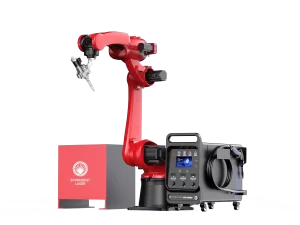
Preparing for Robotic Welding and Automation
Manual welding may be the right starting point for a workshop, but production requirements can change as order volumes increase.
Manufacturers planning to introduce robotic welding should consider automation compatibility before selecting equipment.
Digital I/O interfaces and compatible communication options can support integration, but a complete robotic welding system also requires appropriate robot compatibility, fixtures, programming, safety systems and process validation.
For this reason, buyers should discuss their future automation plans with the equipment supplier before purchase.
A suitable upgrade path can help manufacturers move toward automation without treating the original machine investment as a dead end. The exact integration requirements must still be confirmed for the selected model and robot system.
How to Calculate the ROI of a Handheld Laser Welding Machine
A laser welding machine is a production investment. Its return should be evaluated using real operating costs rather than headline welding speed.
Before requesting a quotation, collect baseline information from your current process:
- Average welding time per component
- Labor hours spent on grinding and polishing
- Rework caused by distortion or inconsistent welds
- Inspection and repair costs
- Daily or monthly production volume
- Consumables and maintenance expenses
- Operator training and equipment integration costs
Then run a trial using representative workpieces and compare the results.
A workshop with high finishing costs and recurring thin-sheet distortion may find a compelling business case for laser welding. Another workshop whose existing process already meets quality, cost and delivery targets may see a smaller benefit.
The result depends on the application, utilization rate, labor costs and the amount of work that can genuinely be eliminated.
Do not calculate ROI from welding speed alone. Calculate it from the total cost of producing an acceptable part.
Is the Master X Series Right for Your Business?
A STRION LASER Master X Series handheld laser welding machine may be worth evaluating if your business regularly encounters:
- Distortion in thin stainless steel sheet metal
- High labor costs for post-weld grinding and polishing
- Inconsistent weld appearance between production batches
- Pressure to improve output without proportionally increasing labor
- A need for flexible welding across different compatible workpieces
- Plans to explore robotic welding or production automation
Laser welding may be less suitable when joint access is restricted, fit-up is inconsistent, required penetration cannot be validated, or the application demands a welding process specified by an existing engineering standard.
Before replacing your current process, test the actual materials, thicknesses and joint configurations. Confirm both weld appearance and engineering requirements, including the applicable inspection criteria.
This approach helps determine whether laser welding can deliver measurable improvements rather than relying on general performance claims.
Request a Master X Series Welding Test and Quotation
Choosing a handheld laser welding machine is an important production decision. The right equipment should match your workpieces, quality requirements and operating conditions.
The STRION LASER Master X Series offers several power configurations for industrial laser welding applications. Our team can help assess your requirements and identify a suitable model for further testing.
To get started, share the following information:
- Material: Stainless steel, carbon steel, aluminum or another metal
- Thickness: The usual and maximum plate thickness
- Joint type: Butt joint, lap joint, corner joint or another configuration
- Application: Electrical enclosures, pipe supports, equipment bases, brackets or other components
- Production needs: Manual welding, finishing reduction or future automation
Contact STRION LASER to discuss your application, request a sample welding test where available, or obtain a customized quotation for the Master X Series.
Website: https://strlaser-en.com
Email: str@strlaser.com
Test your actual workpieces before making the final decision. It is the most practical way to evaluate weld quality, finishing requirements and the potential return on your investment.