El Niño and Extreme Weather: How Can handheld laser welding machines Maintain Stable Production?
Extreme weather is creating new challenges for manufacturers seeking reliable production. As heatwaves and temperature fluctuations place greater demands on industrial equipment, choosing a handheld laser welding machines with effective thermal management becomes increasingly important.
For manufacturers operating under tight delivery schedules, high workshop temperatures can place additional pressure on cooling systems and may contribute to equipment alarms or production interruptions. Maintaining consistent welding quality requires more than high laser power. It also depends on cooling efficiency, welding torch temperature control, suitable operating conditions and preventive maintenance.
STRION LASER addresses these challenges through two key design features: a refrigerant direct-cooling system for overall machine thermal management and an integrated collimation-cap design for handheld laser welding torch heat dissipation.
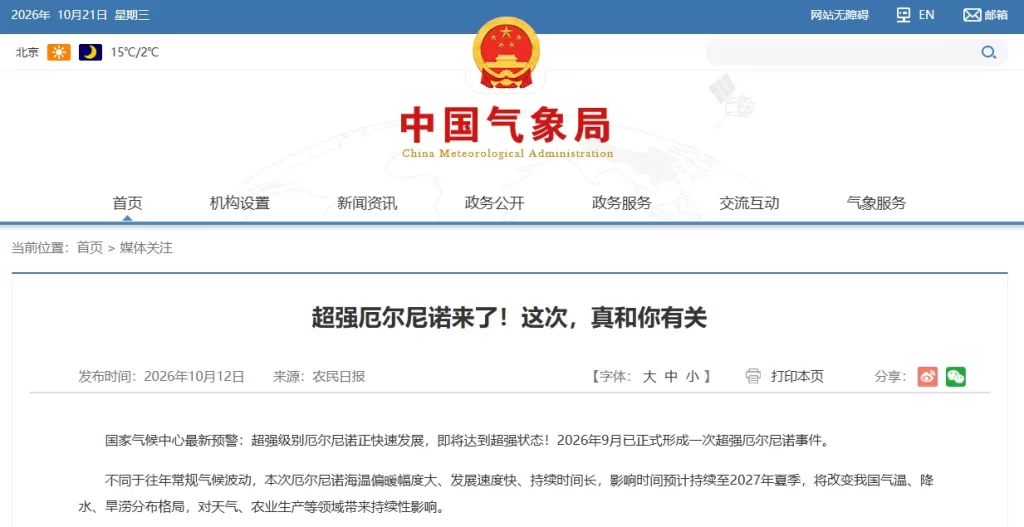
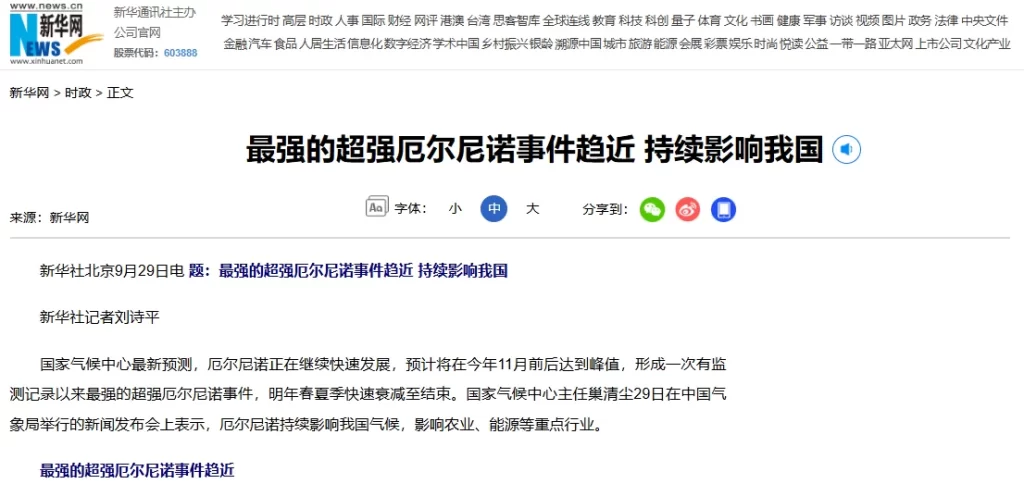
Why Thermal Management Matters in a Handheld Laser Welding Machines
A handheld laser welding machine must manage heat generated by the laser source and other components during operation. When ambient temperatures rise, the cooling system may face a greater thermal load, depending on the equipment design and working conditions.
If the equipment operates outside its specified limits, temperature alarms or protective shutdowns may interrupt production. Thermal management is therefore an important consideration when manufacturers compare handheld laser welding machines for continuous industrial use.
An effective cooling design can help maintain suitable operating conditions, while proper installation, ventilation and preventive maintenance further support equipment reliability.
Refrigerant Direct Cooling for Handheld Laser Welding Machines
Eliminating the Intermediate Heat-Transfer Stage
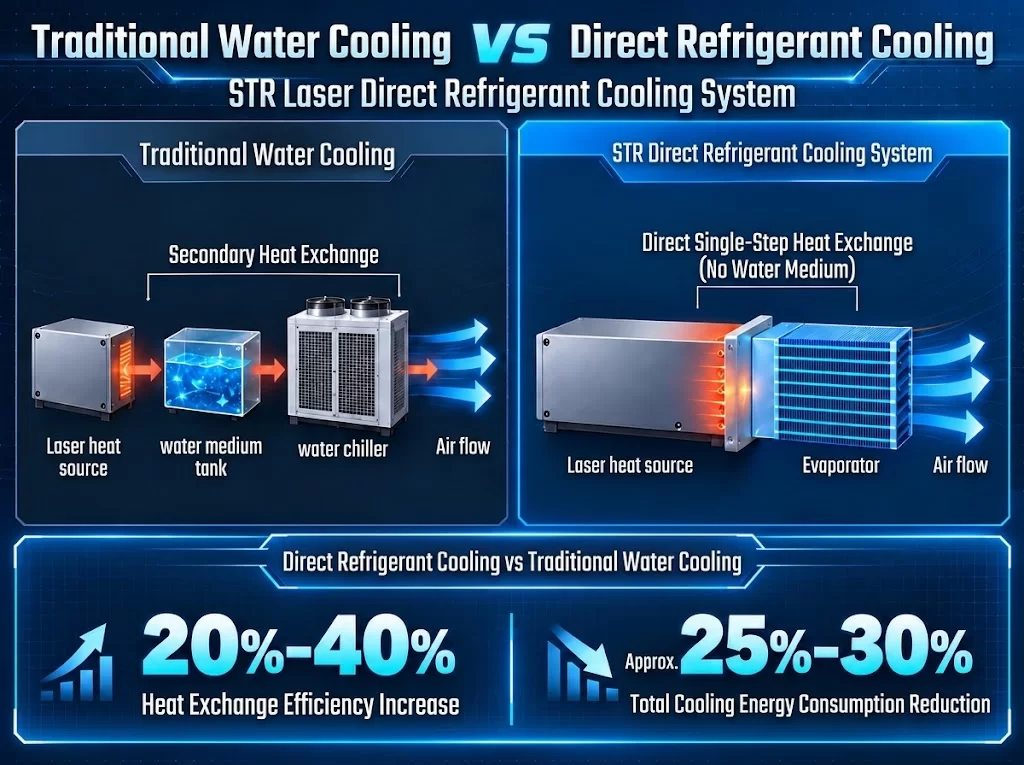
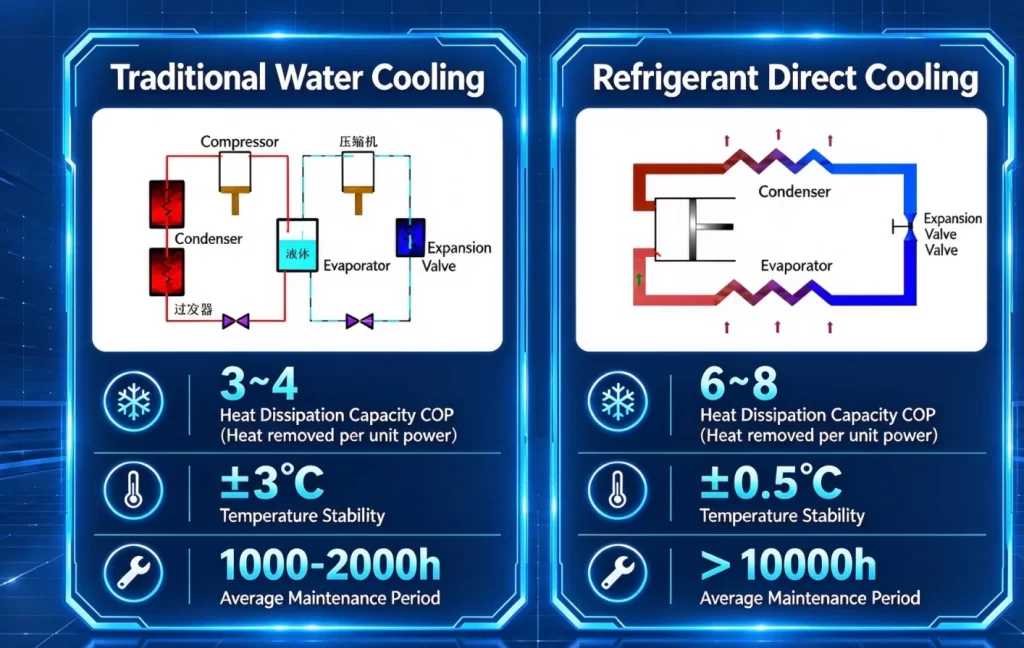
Conventional water-cooled systems typically transfer heat through an intermediate water circuit before releasing it into the surrounding air through a cooling unit. This additional heat-transfer stage introduces thermal resistance, while continuous pump operation consumes electricity. Under high ambient temperatures and demanding workloads, the cooling system must work harder to maintain suitable operating conditions.
STRION LASER’s refrigerant direct-cooling system places the laser heat source in direct thermal contact with the evaporator, eliminating the intermediate water layer. By removing this additional heat-transfer stage, the system is designed to improve heat-transfer efficiency.
According to STRION LASER’s internal technical data, the system can improve heat-transfer efficiency by approximately 20%–40% compared with conventional water-cooling designs.
The system also uses a variable-frequency compressor that adjusts cooling output according to the laser source’s thermal load. Unlike conventional configurations that require continuous water-pump operation, this approach can reduce unnecessary energy consumption when full cooling capacity is not required.
STRION LASER’s reported figures indicate that total cooling-system power consumption can be reduced by approximately 25%–30% compared with conventional water-cooled systems. Actual savings depend on equipment configuration, operating conditions and the comparison baseline.
More Precise Temperature Control for Consistent Laser Output
Temperature stability is another important factor in laser welding performance. Variations in laser-source temperature can affect operating conditions and may contribute to changes in output characteristics and process consistency.
STRION LASER reports typical temperature-control accuracy of approximately ±0.5°C for its refrigerant direct-cooling system, compared with approximately ±3°C for the conventional water-cooling systems used as its benchmark.
By dynamically adjusting cooling output, the system is designed to keep the laser source within a more consistent temperature range. This helps support stable operating conditions and repeatable laser processing.
For manufacturers, stable equipment conditions are an important part of achieving consistent weld formation. However, final weld quality also depends on material properties, joint preparation, shielding gas, wire feeding and welding parameters.
Designed for Demanding Ambient Conditions and Continuous Operation
STRION LASER specifies an ambient temperature range of -30°C to 60°C for its refrigerant direct-cooling system, together with support for continuous operation under its specified operating conditions.
This capability is intended to help manufacturers manage demanding thermal environments. However, the permitted ambient temperature range and continuous-duty rating of the complete machine must be confirmed against the specifications of the selected model and its installation requirements.
The system uses a sealed refrigerant circuit, eliminating routine water-related tasks such as refilling, water replacement and descaling associated with conventional water-cooling circuits. This can simplify certain maintenance procedures and reduce water-circuit maintenance requirements.
For factories operating in hot environments, reduced maintenance complexity and effective thermal management can contribute to more predictable equipment operation.

Welding Torch Thermal Management: Maintaining Consistent Welding Performance
Cooling the laser source is only part of the solution. During prolonged high-power operation, the temperature of the welding torch can also affect optical performance and welding consistency.
As optical components heat up, thermal effects can alter beam characteristics and focal conditions. If the effective focal position changes, weld penetration and bead width may also vary, depending on the material and process parameters.
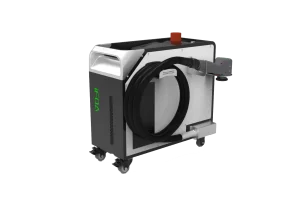
To address this challenge, STRION LASER has developed an integrated collimation-cap design for its handheld laser welding torch.
Integrated Collimation and Cap Design for Better Heat Dissipation
The design increases the optical aperture to improve optical coupling efficiency while expanding the surface area available for convective heat dissipation. The resulting configuration is intended to improve the local heat-dissipation path around the torch output head.
According to STRION LASER’s internal test results, under a continuous 3,000 W output condition, the temperature rise at the welding torch output head remained below 10°C. The company reports an approximately 60% reduction in temperature rise compared with its conventional design benchmark.
The design achieves this without requiring an additional cooling system for the torch.
These results highlight the importance of considering torch thermal management alongside laser-source cooling when evaluating handheld laser welding equipment for extended high-power operation. Test conditions, measurement locations and comparison baselines should be considered when interpreting the figures.
How to Choose a Handheld Laser Welding Machine for Extreme Weather
When evaluating a handheld laser welding machine for demanding production environments, manufacturers should consider the complete operating system rather than laser power alone.
- Cooling architecture: Check cooling capacity, maintenance requirements and performance under the intended ambient conditions.
- Operating temperature limits: Confirm the specified environmental range for the complete machine, not only its cooling system.
- Torch thermal management: Review the torch design and any available test data for extended high-power operation.
- Electrical protection: Verify supply requirements, grounding and protection against power interruptions.
- Process validation: Test the actual materials, thicknesses and joint designs used in production.
- Preventive maintenance: Establish procedures for checking alarms, cooling status and optical components.
No handheld laser welding machine can eliminate every weather-related production risk. Stable output also depends on the workshop environment, electrical supply, operator practices and process control.
STRION LASER Handheld Laser Welding Machines for Industrial Production
For manufacturers comparing handheld laser welding machines, thermal management is an important part of evaluating long-term production suitability. STRION LASER combines refrigerant direct cooling with an optimized torch design to address heat removal at the laser source and temperature rise at the torch output head.
These engineering approaches are designed to support stable operating conditions in demanding industrial applications. The right configuration depends on the specific model, verified technical specifications, workshop environment and production requirements.
Looking for a handheld laser welding machine for your production environment?
Contact STRION LASER to discuss your materials, workpiece thickness, ambient conditions and welding requirements. Our team can help evaluate a suitable configuration and arrange application testing where appropriate.
Website: https://strlaser-en.com
Email: str@strlaser.com