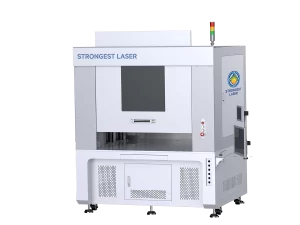
Fiber laser technology is used in equipment for welding, surface cleaning, and additive manufacturing, but the term describes a light-generating architecture rather than a single machine type. A buyer comparing systems may encounter continuous-wave sources, modulated output, pulsed MOPA designs, different fiber-core sizes, and several methods of connecting the source to the processing head. Understanding those distinctions is more useful than selecting equipment from output power alone.
This overview answers three practical questions: what a fiber laser is, why its optical-fiber design is valuable, and how its characteristics affect equipment selection. It introduces the operating principle without repeating a full technical tutorial, then connects the fundamentals to workshop and industrial applications.
What Is a Fiber Laser?
A fiber laser is a solid-state laser whose light-amplifying medium is an optical fiber. The fiber contains a core doped with active ions, usually from rare-earth elements. RP Photonics identifies ytterbium, erbium, thulium, neodymium, and praseodymium among the possible dopants. These ions enable optical gain when the fiber receives suitable pump light, commonly supplied by fiber-coupled laser diodes.
The active fiber has two jobs: it is part of the laser’s light-generating medium, and its waveguide structure directs the light through that medium. That combination differentiates the architecture from laser systems whose active medium is not a fiber. Different dopants and designs support different output characteristics, so “fiber laser” should not be read as a fixed wavelength, power level, or operating mode.
Ytterbium-based industrial fiber sources commonly operate in the approximately one-micrometer region. This helps place the near-infrared specifications of STRION LASER equipment in context: the company’s iFOA pulsed cleaning platforms are specified at 1064 nm, while the STR-AM additive-manufacturing source family is published with a central wavelength of 1080 ± 2 nm. These numbers describe particular product designs, not a universal wavelength for all fiber lasers.
How Does a Fiber Laser Work? The Short Version
At the center of the process is a doped optical-fiber core. Pump diodes deliver energy to the active fiber; the dopant enables that energy to be transferred to the laser field, and the fiber guides the resulting light. A laser resonator can be formed using components such as fiber Bragg gratings, which provide optical feedback. RP Photonics also describes alternative cavity approaches, so fiber Bragg gratings are a common design option rather than a mandatory feature of every device.
High-power designs frequently use double-clad fiber. Instead of launching all pump light directly into the small active core, the system introduces high-power, multimode pump light into a larger inner-cladding region. As the pump light travels along the fiber, the doped core absorbs it. The laser output can then have much higher beam brightness than the incoming pump light. This is why RP Photonics describes the arrangement as a brightness converter.
Core design is important here. A suitable single-mode core can support near-diffraction-limited beam quality, while the broader fiber and pumping architecture determines how much power can be delivered and managed. For a more detailed treatment of pump absorption, the resonator, and optical layout, read the manufacturer’s explanation of how a fiber laser works in detail.
From a machine buyer’s perspective, the main takeaway is that the source is only one part of a working laser system. The delivered beam, output connection, control method, and processing optics must suit the intended operation.
Why the Fiber Format Is Attractive—and Its Limits
Heat management and beam stability
An optical fiber has a large surface area relative to its volume, an advantage for distributing and removing heat generated during operation. RP Photonics describes the architecture as well suited to high-power operation with good beam quality. Unlike a bulky gain medium with stronger thermally induced optical distortion, the guiding properties of a fiber can help preserve beam characteristics. This contributes to the appeal of fiber sources where consistent focusing is important.
Efficient conversion of pump energy
RP Photonics reports that optical-to-optical efficiencies above 50% are typical for high-power fiber-laser designs and that some designs exceed 80%. For ytterbium-based systems, it describes overall electrical-to-optical efficiency on the order of 50% in an appropriate design context. These are technology-level statements, not promises about the electrical consumption of every complete processing machine.
The distinction matters when reading specifications. STRION LASER publishes an electro-optical conversion-efficiency figure of at least 35% for the STR-AM series. That manufacturer-stated value should be evaluated on its own terms rather than replaced by a general figure from a laser-physics reference. Ask which measurement boundary a supplier uses and compare specifications on a consistent basis.
Beam quality is designed, not assumed
A fine optical mode can support a tightly focused spot, but beam quality does not follow from wattage alone. Fiber geometry and operating design affect the output. In equipment selection, beam quality, core diameter, power stability, and the processing-head optics should be reviewed together. A small core may be advantageous for a fine optical mode, but it is not automatically the right choice for every power or application requirement.
Nonlinear effects set real boundaries
High-power fiber technology also faces physical limits. RP Photonics identifies stimulated Raman scattering (SRS) and stimulated Brillouin scattering (SBS) as nonlinear effects that can become important in fiber devices. In particular, sufficiently strong stimulated Brillouin scattering can create unwanted backward reflection, limiting usable operating conditions.
Designers address these issues through fiber and system engineering, including suitable mode-area choices where applicable. These constraints should not be hidden behind a simple claim that higher power or smaller cores are always better. The practical question is whether a proposed source delivers the needed power, quality, and control within the operating regime it was designed for.
Fiber Lasers in Welding
Continuous or modulated near-infrared fiber sources are used in industrial laser-welding equipment. A beam with high brightness can be directed through suitable optics to a concentrated working spot. That concentration is relevant to achieving the heat input and weld geometry a particular seam requires, although actual penetration and appearance still depend on material, thickness, speed, focus, and joint conditions.
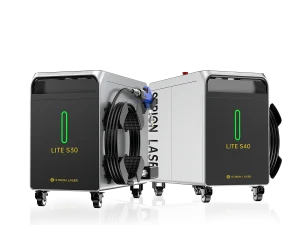
STRION LASER’s range of handheld laser welding machines includes the Lite-S, STR-HW, and Master families. The company’s handheld configurations use self-developed fiber-laser sources, and its STR-HW line emphasizes small-core-diameter technology. Wobble welding heads provide another process variable by moving the working beam in a controlled pattern.
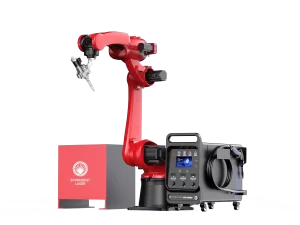
These features belong to different layers of equipment selection. The source establishes optical capability; the head determines how the beam is delivered or moved; and the fixture, operator, or automation determines the practical path along the part. When comparing welding systems, ask about the complete combination rather than treating the laser source as if it guarantees a specific seam result.
Where a seam requires concentrated energy, beam quality becomes relevant to the available focus. Near-diffraction-limited operation, often described by an M-squared value close to one, is useful context for fine spots. It is not a standalone claim about achievable weld depth or production speed.
Fiber Lasers in Surface Cleaning
Cleaning and welding use laser energy differently. A cleaning application is concerned with the interaction between pulses and material at or near a surface, rather than continuously joining a seam. For that reason, pulse behavior can become as important as the nominal power number.
MOPA pulsed-fiber architectures provide ways to control pulse characteristics, including pulse width and repetition frequency, to suit the required interaction. That flexibility gives process engineers variables to evaluate when matching pulse delivery to the absorption response of a contaminant and the requirements of the underlying surface. It does not mean that every coating or substrate can be handled with one universal setting.
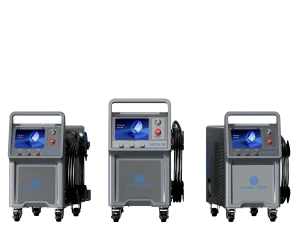
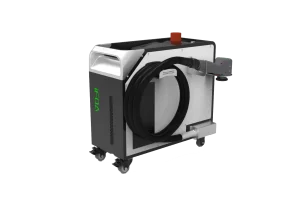
STRION LASER offers iFOA MOPA laser cleaning machines based on 1064 nm sources, with 300 W and 500 W platforms identified in the manufacturer’s product information. For a potential application, define what must be removed, what surface must remain, and which sample conditions represent normal production. Those requirements are a better basis for discussing a platform than assuming that a power rating alone predicts the cleaning result.
Fiber-laser cleaning is another illustration of why operating mode matters. Two sources may be described as fiber lasers while delivering light in very different temporal patterns for different industrial tasks.
Fiber Lasers in Additive Manufacturing
Additive-manufacturing equipment introduces its own priorities. An integrator needs a suitable optical output, stable power behavior, control interfaces, and coordination between the laser source and the larger manufacturing platform. Fine-beam operation can be valuable for controlling the intended processing region, but the final melt-pool behavior is a system outcome rather than a specification of the fiber core by itself.
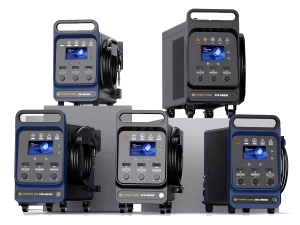
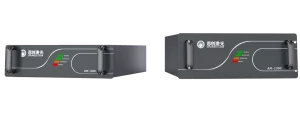
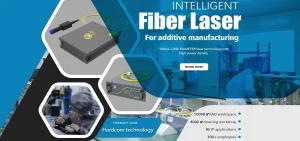
STRION LASER’s STR-AM fiber laser series for additive manufacturing includes STR-AM-R350, R500, R750, and R1000 models spanning 350–1000 W, as well as M350 and M500 variants. The manufacturer lists a central wavelength of 1080 ± 2 nm, continuous-wave and modulated operation, modulation up to 20 kHz, continuous-power instability of ±1%, and a published beam-quality figure below 1.1.
The STR-AM specifications also identify a 10-micrometer output-fiber core, QCS or QBH output connections, RS232, Ethernet, and analog control options, and water cooling. Together, these details show why an integrator should examine more than optical power: source control and physical integration may determine whether the proposed equipment fits an existing machine architecture.
The narrow output-fiber specification is particularly relevant to discussions about fine optical modes, but it should not be converted into a promised spot size or melt-pool dimension without the complete optical and process design. For a deeper purchasing framework, see the fiber laser selection guide for additive manufacturing.
How to Choose Fiber Laser Equipment
Begin with the process requirement and work back to the optical source. A purchasing specification is more useful when it separates what the finished process must accomplish from what the laser itself is required to supply.
- Define the application: Is the machine welding a seam, delivering pulses for surface cleaning, or integrating into an additive-manufacturing platform? Include materials, expected working geometry, and production pattern.
- Choose the appropriate operating mode: Determine whether continuous, modulated, or pulsed operation is relevant. Do not assume that two fiber sources with similar rated power are interchangeable.
- Review wavelength and beam quality: Confirm the source wavelength, beam-quality specification, output-fiber core, and compatibility with the intended optics. The manufacturer’s article comparing small-core and large-core fiber lasers provides a related technical decision point.
- Check stability and efficiency definitions: Ask how continuous-power stability and electrical-to-optical efficiency are specified. Compare like with like rather than combining general technology claims with a product rating.
- Verify mechanical and control interfaces: Document output connections, available command interfaces, cooling requirements, and the responsibilities of the source and machine controllers.
- Request supporting qualification information: Ask the supplier what relevant reliability-testing information, documentation, and application-trial options can be provided for the proposed system. Do not assume a test or certification exists unless the supplier establishes it.
This approach keeps specification discussions grounded in the needs of a complete machine. It also makes comparison easier when different suppliers emphasize different numbers.
Frequently Asked Questions About Fiber Lasers
What wavelength does a fiber laser use?
There is no single wavelength for every fiber laser because wavelength depends on the dopant and design. Ytterbium-based industrial sources often operate near one micrometer; STRION LASER publishes 1064 nm for its iFOA cleaning platforms and 1080 ± 2 nm for its STR-AM sources.
What is the main difference between a fiber laser and a CO2 laser?
They are different laser-source technologies, so a buyer should compare the source characteristics and the needs of the intended process rather than assuming that either is universally superior. The manufacturer’s fiber laser versus CO2 laser comparison explores that equipment-selection question separately.
Are all fiber lasers continuous-wave machines?
No. The equipment described here includes continuous-wave or modulated sources and MOPA pulsed-fiber designs. The operating mode should be selected according to whether the task is welding, cleaning, or integration into another process.
Does a smaller fiber core always produce a better industrial result?
No. Core design affects beam behavior, but power handling, nonlinear effects, output optics, and process requirements also matter. Evaluate the complete optical system and the intended application rather than treating core diameter as a universal ranking.
Discuss your fiber laser requirements. Whether you are evaluating handheld welding equipment, a pulsed cleaning platform, or a source for additive-manufacturing integration, share the application, desired operating mode, power range, beam and interface requirements with STRION LASER. Contact the technical team to discuss specifications and possible equipment configurations for your project.