Choosing a fiber laser source for additive manufacturing means matching the source to the optics, scan strategy, controls, and qualification requirements of a metal printing platform. Rated watts are only one part of that decision. The useful specification describes how the beam behaves at the required settings and how consistently the complete platform can apply it.
Why the laser source defines an AM platform
The source contributes the optical power and beam properties that the delivery system uses at the powder bed. Spot size and energy distribution are therefore system questions. Review the laser, collimation, scan optics, working distance, and operating settings together when defining the intended melt-pool behavior and feature requirements.
A source change can require renewed optical and process evaluation, even if nominal output power stays the same. Agree early on which characteristics must remain consistent across production units and replacement units. The introduction to how laser 3D printing works provides context for locating the source within the wider printing process.
For a machine builder, selection should produce an integration specification and an acceptance plan. Define the alloy, build volume, layer strategy, scan system, productivity target, and required output quality before asking suppliers to recommend a power class.
Power and the 10 μm core trade-off
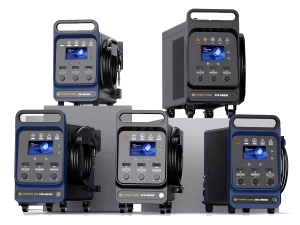
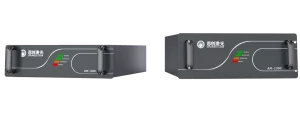
According to the manufacturer, the STR-AM laser source for additive manufacturing includes R350, R500, R750, and R1000 models rated at 350, 500, 750, and 1000 W. The M350 and M500 models provide 350 and 500 W. The published output fiber core diameter is 10 μm.
Use the 350 W, 500 W, and 1 kW classes as candidates for your platform study. Higher rated output may provide more available energy, but a useful productivity gain must be demonstrated in the qualified process. Do not assume that doubling the rating doubles accepted build output. Feature requirements, scan strategy, and the rest of the machine remain part of the result.
A 10 μm fiber core is not a 10 μm working spot or a promise of that feature resolution. Request the delivered beam characteristics and calculate or measure the focused result with the intended optics. Small-core construction and near-diffraction-limited beam quality should be considered together, while the actual mode characteristics require the supplier’s measurement documentation.
| Selection variable | Published STR-AM value | Integration question |
|---|---|---|
| Rated output | 350–1000 W across listed models | Which model supports the required process window? |
| Central wavelength | 1080±2 nm | Are delivery optics and measurement equipment suitable? |
| Output regulation | 5–100% | How does output behave across the settings actually used? |
| Fiber and connector | 10 μm core; QCS/QBH output | What exact mechanical and optical interface is supplied? |
Beam quality and why M² matters
Beam quality describes how closely a real beam approaches the propagation behavior of an ideal Gaussian beam. The beam parameter product, or BPP, is the beam-waist radius multiplied by the far-field divergence half-angle. M² expresses that product relative to the ideal Gaussian value at the same wavelength.
BPP = w₀ × θ; M² = π × w₀ × θ / λ. Use consistent units. A lower M² or BPP indicates better beam quality in this sense. The definitions are explained by RP Photonics, while beam-measurement guidance discusses ISO 11146 methods using beam-size measurements along the propagation axis.
STRION LASER publishes beam quality below 1.1 for STR-AM. Ask the supplier to confirm the metric, measurement method, operating power, and acceptance conditions. If confirmed as M², this indicates near-diffraction-limited performance. It does not independently specify the spot produced by your scan optics.
For a fine-feature platform, evaluate focusability and working-distance requirements using the complete optical arrangement. Request beam-quality results at the relevant settings and after the agreed acceptance run. Purchase price alone does not establish whether another source’s beam quality will degrade. Compare measurements and test conditions rather than assuming a relationship between a low quotation and poor stability.
The site’s explanation of how fiber lasers work is useful background when reviewing terminology with mechanical and controls teams.
Modulation and control response
The published STR-AM specification includes continuous-wave and modulated operation, maximum modulation frequency of 20 kHz, emission-on response of 25 μs, and emission-off response of 20 μs. These describe different aspects of control and should not be collapsed into one assumed pulse specification.
Ask how modulation frequency is defined, how response time is measured, and what output waveform results at the intended duty and power settings. A maximum frequency does not guarantee arbitrary pulse shapes or identical output for every command sequence. For LPBF scan strategies, verify command timing against the measured optical response.
RS232, Ethernet, and analog interfaces are listed. Establish which interface handles configuration, which handles time-critical emission control, and how faults are reported. An interface name does not guarantee direct compatibility with every scan-head controller. Request the protocol, signal levels, timing diagrams, and fault-state behavior before finalizing the control architecture.
Stability over thousands of hours
According to the manufacturer, continuous power instability is ±1%, electro-optical conversion efficiency is at least 35%, and the source is water-cooled with a listed operating temperature of 10–40 °C. Treat these as supplier specifications with measurement conditions to establish during procurement.
Ask over what duration and output range instability is measured, whether warm-up is included, and which environmental conditions apply. A short-term stability number is not a guarantee of unchanged output over thousands of operating hours. Require the evidence relevant to your platform’s maintenance and recalibration plan.
Efficiency also needs a clear boundary. Determine whether the quoted figure describes the laser unit and what auxiliaries are excluded. For printer operating cost, include the actual electrical demands of cooling and the rest of the machine. Do not substitute a source efficiency figure for whole-platform energy consumption.
STRION LASER publishes a reliability program with more than 50 tests, including thermal shock, 85 °C/85% relative-humidity storage, vibration, drop testing, and 120-hour factory aging. Storage or qualification stress conditions are not operating limits. Request the applicable test procedure, sample basis, and acceptance record for the model being considered.
Multi-laser architectures
For a printer with several laser channels, compare repeatability across units as well as the specifications of one sample. Define how channels will be measured, calibrated, and matched. A shared model name is not a substitute for an acceptance tolerance across the delivered set.
Build the commercial comparison around cost per installed, qualified channel. Include the sources, optics, cooling allocation, controls, integration, calibration, and service inventory. Then evaluate accepted build output for the proposed architecture. Adding channels should be assessed through the machine’s actual workflow rather than an assumed linear productivity multiplier.
Discuss how a replacement channel will be brought back into the qualified system. Ask whether the supplier can provide consistent documentation, unit-level results, and change notifications across future orders. For application context, review the manufacturer’s additive manufacturing applications, then define the evidence required for your own platform.
Supplier evaluation checklist
- Wavelength: confirm the specified tolerance and its relationship to your delivery and measurement optics.
- Power range: request measured behavior at the low, nominal, and high settings used by the process.
- Beam quality: identify the metric, method, test power, and acceptance tolerance.
- Optical interface: confirm connector, fiber length, output geometry, and handling requirements.
- Control documentation: review protocols, timing, command behavior, and fault reporting with the controls team.
- Stability: agree on duration, environmental conditions, warm-up, and allowable variation.
- Cooling: obtain required coolant conditions, utilities, and installation limits for the selected model.
- Reliability evidence: request relevant aging and stress-test records, including acceptance criteria.
- Compliance documents: obtain actual declarations or certificates and verify the model and scope rather than relying on a list of logos.
- Supply and service: establish capacity, change control, technical support coverage, spare-unit strategy, and documentation for repeat orders.
FAQ
What power fiber laser should I choose for 316L LPBF?
The alloy alone does not determine power. Provide layer thickness, optical spot requirements, scan strategy, and productivity targets. Select a candidate source and validate the process window on the intended platform.
Is single-mode always better than multimode for AM?
Choose the beam characteristics required by the application. For fine-feature work, low M² can be relevant to focusability, but the delivery optics and qualified process determine the useful result. Request measured mode and beam data rather than relying on the label alone.
Does 20 kHz modulation mean any pulse shape is possible?
No. Review the supported command behavior and measured optical waveform, including turn-on and turn-off response. Validate synchronization with the scan system under the intended operating sequence.
What should an integrator send when requesting a proposal?
Share the build volume, material family, layer thickness, scan system, channel count, and target productivity. Contact STRION LASER for specifications and a quotation so the team can discuss a laser source configuration proposal for your platform.