Welding is a fundamental process in manufacturing, construction, and metalworking, providing strong and reliable joints across a wide range of materials. When comparing laser welding vs MIG welding, manufacturers often evaluate factors such as welding speed, precision, heat input, and overall production efficiency. Two commonly used welding methods, laser welding and MIG (Metal Inert Gas) welding, each offer unique benefits and are suited to different applications. A laser welder vs MIG system comparison shows that laser welding excels in precision, automation, and speed, while MIG welding is known for its versatility, affordability, and ease of use. This article explores the key differences between laser and MIG welding, helping readers determine the best welding solution for their specific production and fabrication needs.
What is Laser Welding?
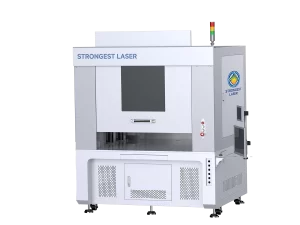
Laser welding utilizes a high-energy laser beam to fuse materials, creating a precise and clean joint. This concentrated energy allows the laser to form a small, intense weld pool with minimal distortion to surrounding materials. Fiber lasers, CO₂ lasers, and diode lasers are the primary types used, each suited to various metals and thicknesses. Laser welding setups require sophisticated equipment, including a laser source, optics for focusing, and protective measures to safeguard operators. Known for its precision, laser welding is especially effective for intricate designs and thin materials, delivering high-quality, low-distortion welds quickly.
What is MIG Welding?
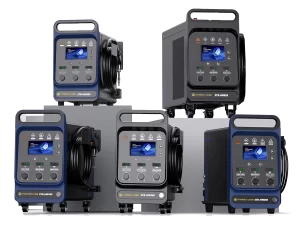
Many laser welding machine manufacturers like STRION LASER utilize a high-energy laser beam to fuse materials, creating a precise and clean joint. This concentrated energy allows the laser to form a small, intense weld pool with minimal distortion to surrounding materials. Fiber lasers, CO₂ lasers, and diode lasers are the primary types used, each suited to various metals and thicknesses. Laser welding setups require sophisticated equipment, including a laser source, optics for focusing, and protective measures to safeguard operators. Known for its precision, laser welding is especially effective for intricate designs and thin materials, delivering high-quality, low-distortion welds quickly.
Comparative Analysis: Laser Welding vs MIG Welding
1. Welding Speed and Efficiency
Laser welding is known for its speed, often completing welds significantly faster than MIG, especially for thin and medium-thickness materials. Its speed can improve throughput, making it ideal for high-volume manufacturing. MIG welding, while slightly slower, can be more efficient on thicker sections where multiple laser passes would be needed.
2. Weld Quality and Precision
Laser welding creates smooth, high-precision welds with minimal spatter and oxidation. Its concentrated heat input results in a smaller heat-affected zone, reducing the likelihood of warping or distortion. MIG welding, while less precise, produces robust joints that are strong and reliable, especially useful when precision isn’t a primary concern, such as in structural applications.
3. Material Compatibility
Laser welding is well-suited for metals like stainless steel, aluminum, and titanium, especially in thin sheets. MIG welding, on the other hand, can handle a broader range of materials, including thicker sections of carbon steel, stainless steel, and aluminum, providing robust joints in these applications.
4. Cost Implications
Laser welding machines typically have a higher initial cost due to the sophistication of the laser source and optical equipment, making them better suited to industries with high precision needs and budget flexibility. However, their low maintenance and high efficiency can yield savings over time. MIG welding equipment, more affordable upfront, offers cost-effectiveness in small-scale operations or environments where extensive precision is not essential.
5. Ease of Use and Operator Skill Requirements
MIG welding is known for its simplicity, with a short learning curve and minimal setup. It’s more forgiving of operator technique and is adaptable to various positions. Laser welding, although increasingly user-friendly, requires more specialized training to operate safely and effectively.
6. Environmental and Safety Factors
Safety is a crucial consideration in both methods. Laser welding requires stringent protective measures due to the high-energy beams, while MIG welding produces fumes and spatter, necessitating adequate ventilation and protective gear. In terms of energy consumption, laser welding is more efficient for thin materials, though its higher power requirements for thicker materials can increase energy usage.
Laser Welding vs MIG Welding Strength
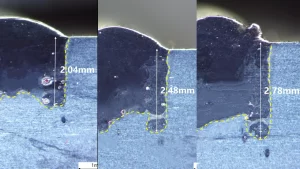
One of the most common questions is about laser welding vs MIG welding strength. In many applications, laser welds can achieve equal or even higher weld strength compared to MIG welding because of their deeper penetration and narrower heat affected zone.
Laser welding creates highly concentrated and consistent weld seams with reduced thermal distortion. This improves structural integrity while maintaining material properties. MIG welding can also produce strong welds, especially for thicker materials, but inconsistent heat input may increase distortion or spatter.
For stainless steel, aluminum, and precision fabrication, laser welding vs MIG welding strength comparisons often favor laser technology due to cleaner fusion and better repeatability.
Industry Applications: Laser Welding vs MIG Welding
Automotive: Laser welding is ideal for high-precision tasks in automotive manufacturing, such as body panels and electric vehicle battery enclosures. MIG welding, however, remains essential in body frame construction and repairs, providing strong joints for thicker metal parts.
Aerospace: In aerospace, precision and strength are paramount. Laser welding’s low-distortion welds make it ideal for lightweight, thin materials, while MIG welding can be used in less precision-focused tasks where structural strength is prioritized.
Manufacturing and Metal Fabrication: In general manufacturing, both methods are widely used. MIG welding is commonly used for structural components and metal furniture, while laser welding is employed for detailed or small-scale fabrication.
Electronics and Medical Device Manufacturing: Laser welding offers unparalleled precision for electronic components and medical devices, where welds must be clean, consistent, and minimal in size.
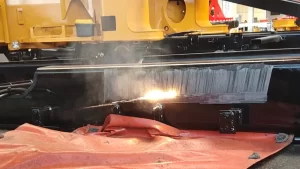
Construction and Heavy Equipment: In construction, MIG welding’s adaptability to thicker metals and complex positions makes it invaluable for building structures and repairing heavy machinery.
Future Trends and Technological Advancements
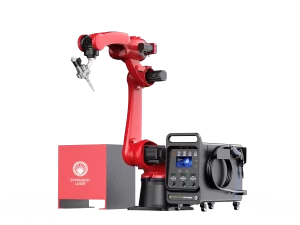
Both laser and MIG welding technologies are advancing rapidly. Laser welding is evolving with more powerful lasers, making it suitable for thicker materials and larger applications. Robotic integration is also on the rise, allowing laser welders to work in tandem with automation for even greater precision and speed. In MIG welding, innovations in wire feed technology and shielding gases are enhancing efficiency and adaptability, further solidifying its position in structural applications. Hybrid welding systems that combine laser and MIG welding are also emerging, combining the precision of lasers with the robustness of MIG welding.
Conclusion
Laser welding and MIG welding each bring distinct advantages, suited to different applications and industry needs. Laser welding offers high-speed, precise welds, ideal for electronics, automotive, and other precision-driven sectors, though it comes with a higher initial investment. MIG welding provides strong, versatile joints at a lower cost, fitting well in construction, heavy equipment, and general manufacturing. Choosing between laser and MIG welding depends on factors like material type, required precision, budget, and application scale. As welding technology advances, both methods are likely to find even broader use, enhancing manufacturing capabilities and efficiency across industries.
FAQs about Laser Welding vs MIG Welding
Q1: Is laser welding stronger than MIG welding?
A1: In many precision manufacturing applications, laser welding vs mig comparisons show that laser welding can be stronger than MIG welding because it creates deeper penetration and smaller heat affected zones with less distortion.
Q2: Can laser welding replace MIG welding?
A2: When evaluating mig vs laser welding, laser welding can replace MIG welding in many industries including automotive, stainless steel fabrication, battery manufacturing, and sheet metal processing. However, MIG welding still performs well for thick structural steel applications.
Q3: Which is better: laser welding or MIG welding?
A3: The answer depends on the application. In mig welding vs laser welding decisions, laser welding is better for speed, precision, and automation, while MIG welding is better for low-cost heavy fabrication.