Laser Welding Parameter Setting Guide for Better Weld Quality
In modern metal fabrication, choosing the right laser welding parameters is the key to achieving stable weld quality, deeper penetration, and a cleaner weld seam. Whether you are working with stainless steel, galvanized steel, carbon steel, or aluminum alloys, parameter settings such as power, wire feed speed, wobble width, and frequency directly determine the final welding result.
For manufacturers in industries such as automotive parts, sheet metal fabrication, kitchen equipment, pressure vessels, and metal furniture, improper settings often lead to common issues including black weld seams, insufficient penetration, burn-through, and poor weld appearance.
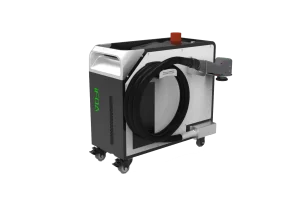
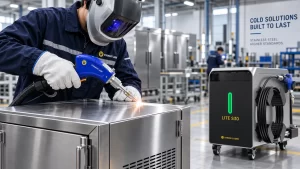
This professional guide from STRION LASER explains how to optimize your handheld laser welder settings for better productivity and consistent welding performance.
Why Laser Welding Parameters Matter
Unlike traditional arc welding, handheld laser welding is highly dependent on parameter precision. Even small changes in power output or wire feed speed can significantly affect the weld seam.
The most important parameters include:
- Laser power
- Wire feed speed
- Welding speed
- Wobble width
- Oscillation frequency
- Spot welding mode
These settings influence:
- weld penetration depth
- seam width
- surface brightness
- heat affected zone
- spatter control
- burn-through risk
A well-optimized setup improves both welding efficiency and cosmetic appearance.
How Power Affects Laser Welding Results
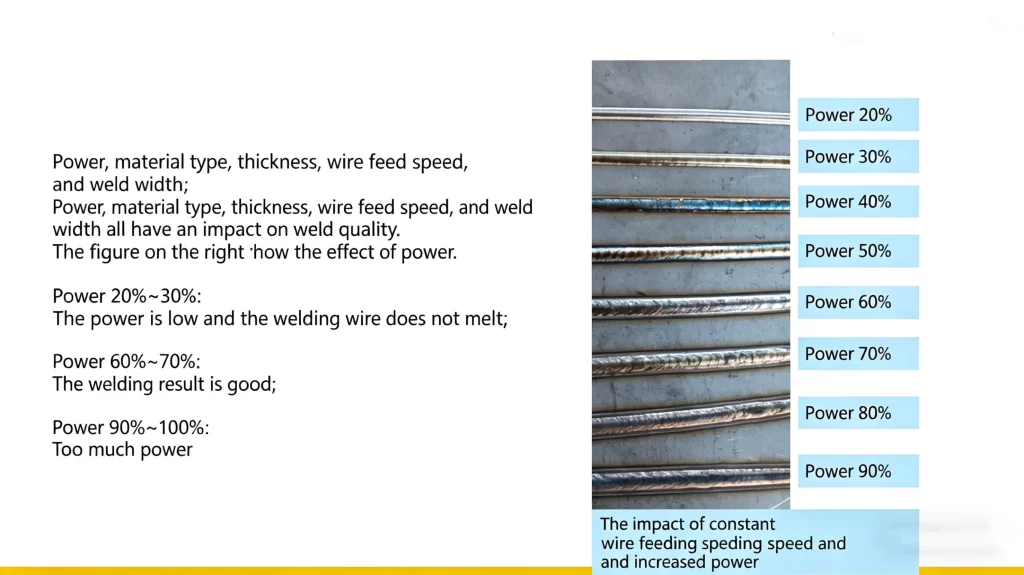
Power is the most critical parameter in laser welding.
Low Power (20%–30%)
When the power is set too low, the filler wire may not fully melt.
Typical problems include:
- poor fusion
- weak weld joint
- shallow penetration
- discontinuous seam
This is common when welding thicker materials with insufficient power.
Medium Power (60%–70%)
For most common sheet metal applications, this range delivers the best welding result.
Advantages include:
- smooth weld seam
- stable penetration
- bright surface finish
- low deformation
This setting is often recommended for 1–3 mm stainless steel and galvanized steel.
High Power (90%–100%)
Excessive power can cause overheating.
Typical issues include:
- black weld seam
- oxidation
- excessive melting
- burn-through
- wider heat affected zone
If the weld seam turns dark or burnt, reducing power is usually the first adjustment.
Best Wire Feed Speed for Laser Welding
Wire feed speed must match the power level.
If the wire speed is too fast, the laser energy may be insufficient to fully melt the filler wire.
If it is too slow, excessive heat concentration may occur.
20–30 cm/min
This range may lead to:
- overheating
- dark weld color
- excessive buildup
- poor seam flatness
40–60 cm/min
This is usually the optimal range for most production welding.
Benefits include:
- uniform seam formation
- stable melting
- excellent cosmetic result
80–100 cm/min
Excessive feed speed may result in:
- incomplete melting
- wire stacking
- unstable seam continuity
For best results, wire feed speed should always be adjusted together with laser power.
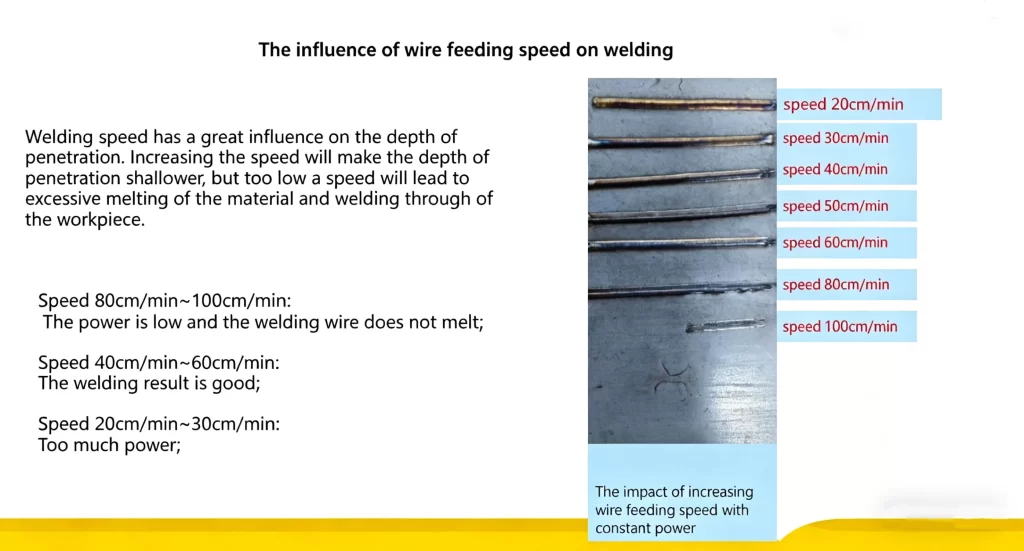
How Welding Speed Affects Penetration
Welding speed directly affects penetration depth.
High Speed
When travel speed is too fast:
- penetration becomes shallow
- seam width narrows
- bonding strength may decrease
Low Speed
When speed is too slow:
- material overheats
- distortion increases
- workpiece may burn through
For thin sheet applications, proper balance is critical.
In most cases, maintaining a consistent hand movement speed is one of the most important operator skills.
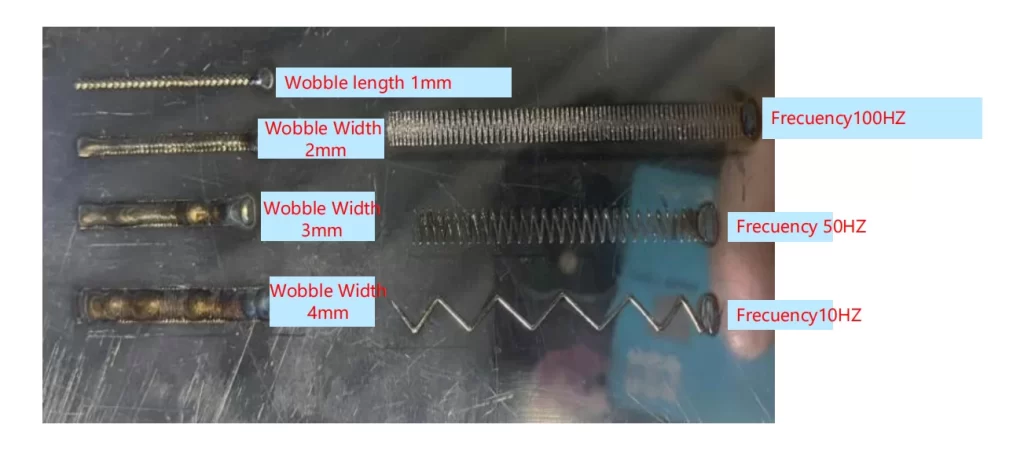
How Wobble Width and Frequency Affect Weld Seam
Wobble welding is widely used in handheld laser welders to improve gap bridging and seam width.
Wobble Width (1–4 mm)
A smaller wobble width creates:
- narrower seam
- deeper penetration
- concentrated heat input
A larger wobble width creates:
- wider seam coverage
- better tolerance for assembly gaps
- smoother appearance
For example:
- 1 mm: narrow precision welding
- 2 mm: standard seam welding
- 3–4 mm: wider gap filling
Frequency (10–100 Hz)
Frequency controls oscillation speed.
Higher frequency typically gives:
- smoother seam surface
- finer weld pattern
- better cosmetic appearance
Lower frequency often provides:
- stronger energy concentration
- deeper penetration
For decorative stainless steel welding, higher frequency is usually preferred.
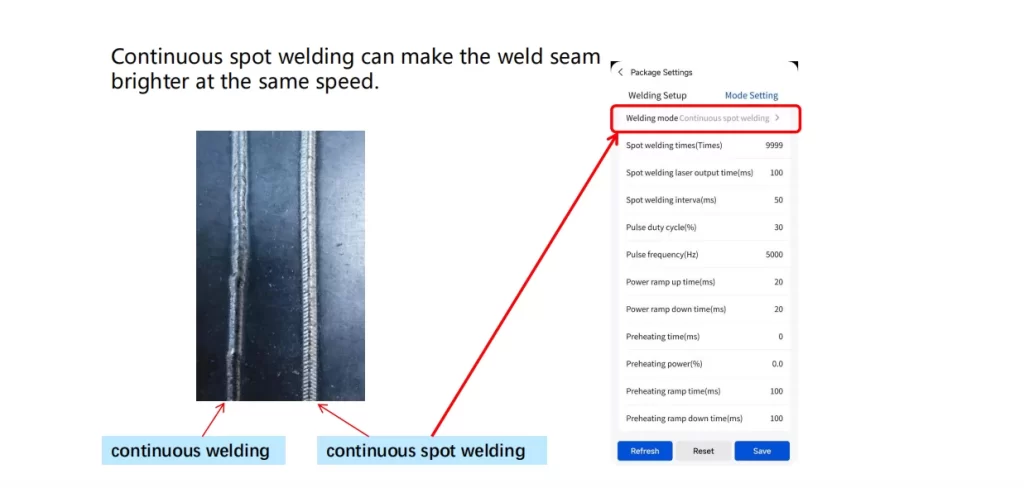
Continuous Welding vs Continuous Spot Welding
Many customers ask why their weld seam does not appear bright enough.
One highly effective method is using continuous spot welding mode.
Compared with normal continuous welding, continuous spot mode often provides:
- brighter weld seam
- reduced heat accumulation
- better surface aesthetics
- improved oxidation control
This is especially useful for visible stainless steel surfaces, furniture frames, and kitchen equipment.
Recommended Settings for Different Materials
Stainless Steel
Recommended for 1–2 mm:
- Power: 50–70%
- Wire speed: 40–60 cm/min
- Wobble width: 1–2 mm
- Frequency: 50–100 Hz
Ideal for:
- cabinets
- kitchenware
- decorative panels
- pressure piping
Galvanized Steel
Recommended:
- medium power
- moderate travel speed
- stable shielding gas
Proper settings help reduce zinc layer burning and discoloration.
Aluminum Alloy
Aluminum requires more precise energy control due to high reflectivity.
Recommended:
- higher power density
- smaller wobble width
- stable wire feeding
This is commonly used for:
- automotive parts
- wheelchair accessories
- bicycle components
Recommended Laser Cutting Parameters
For handheld laser cutting mode, the recommended settings are:
- Power: 100%
- Frequency: 20–50 Hz
- Wobble Width: 0–0.2 mm
When using a cutting nozzle, ensure the beam exits from the center for stable cutting performance.
This setup is suitable for thin metal sheet cutting and edge trimming.
Common Problems and Solutions
Why does the weld seam turn black?
Possible causes:
- excessive power
- slow travel speed
- insufficient shielding gas
Why is the wire not melting?
Possible causes:
- power too low
- wire feed speed too high
Why does the sheet burn through?
Possible causes:
- speed too slow
- excessive power
- wobble width too narrow
Final Thoughts
Optimizing laser welding parameters is the foundation of achieving strong, clean, and efficient welds.
By properly adjusting power, wire feed speed, welding speed, wobble width, and frequency, manufacturers can significantly improve weld quality while reducing rework and production cost.
At STRION LASER, we provide professional handheld laser welding solutions and application support for global customers across automotive, sheet metal, furniture, and industrial manufacturing sectors.
If you need recommended parameters for your specific material thickness, contact our technical team for customized welding solutions.
STRION LASER – Professional Laser Welding Solutions for Global Manufacturing.